Sizing and mounting an aquarium LED light, and what it will not do
A light bought to the tank's "four-foot" label leaves a dark band at one end, and a driver tucked inside the hood ends up with corroded connector pins. Nearly every aquarium lighting problem we hear about is one of those installation decisions rather than the light itself.
Key takeaways
- Measure the hood or rim opening. A "four-foot" tank can open anywhere from 110 to 122 cm.
- Everything electrical stays above the waterline; the driver goes on a shelf below the tank with a drip loop in the cable.
- Run the light 6–8 hours a day on a schedule. All-day lighting feeds an algae bloom within a couple of weeks.
- This is a white display light on Lotus Lantern — not RGB, and not a reef or planted-tank grow light.
- A GFCI or RCD on the tank's outlet is a small retrofit; the 2023 NEC requires it for aquariums in shops and offices.
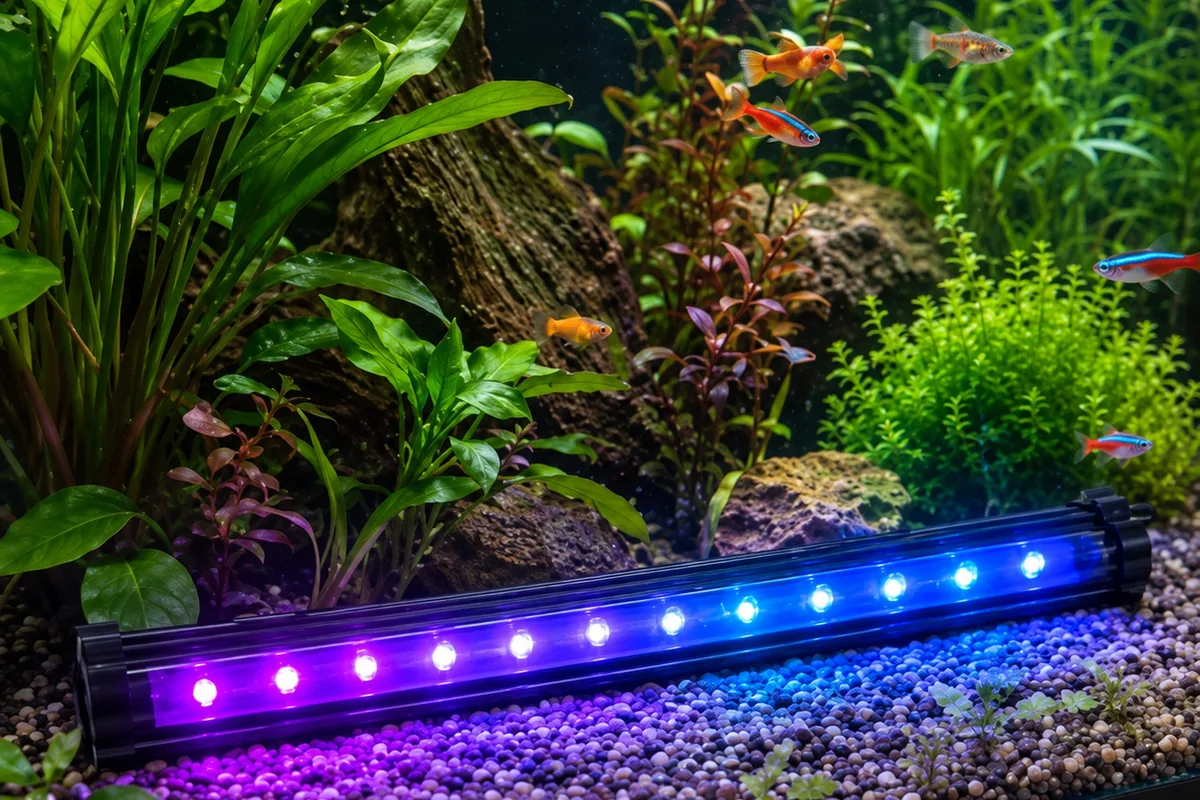
Which kind of aquarium light do you need?
Our aquarium light is a white display light. It runs on the Lotus Lantern app, the same app as our other single-colour and tunable-white fixtures, and gives adjustable brightness plus adjustable colour temperature on the tunable models. It is built to make the tank look right from across the room. It does not cycle through colours, and it does not replace a grow light.
| Light type | What it does | Tank it suits | Our aquarium light |
|---|---|---|---|
| Display / viewing light | White, dimmable, warm-to-cool on tunable models | Any tank that is looked at more than it is farmed | Yes |
| Planted-tank grow light | Set PAR at the substrate, strong red and blue | Carpet plants, high-light stems, CO₂ tanks | No — keeps low-light plants alive only |
| Reef light | 10,000K and up with blue channels for coral | Coral that depends on high light | No — lights a reef tank for viewing only |
| RGB accent light | Colour-changing effects | Around the stand, never inside the hood | Different product line |
Anubias, java fern and mosses do fine under a display light. A carpet plant or a stony coral wants a fixture designed for that job. Buy for the tank you look at, not the tank you farm.
Sizing the light to the tank
- Measure the opening, not the label. Run a tape across the inside of the hood or the rim where the light will sit. A "four-foot" tank can open anywhere from about 110 to 122 cm depending on the frame style, and the marketed size does not tell you which.
- Match the lit length to that opening. A light sized to the water's edge rather than the rim leaves a dark band at one end. From directly above it looks fine; from the sofa, where the tank is actually watched, the unlit end is the first thing you see.
- On a rimless tank, use a clip bracket. Clip brackets adjust to the glass thickness, which changes with tank size. An adhesive pad on glass lets go the first time the pane is cleaned with an ammonia-based glass cleaner, and the light lands on the substrate.
Keeping water away from the electronics
This fixture is not designed to be submerged. It mounts above the waterline, on the rim or inside the hood. Low-voltage DC is safer than mains around water but it is not zero-risk, and a fixture rated for splash above the surface is a different product from one rated for submersion. Never use a rim-mounted light's rating to justify putting it, or its driver, in the water.
On a covered display tank the hazard is not splashing. It is condensation. A glass or acrylic hood traps warm, humid air directly under the fixture, and the driver and connector are the coolest metal surfaces in that space, so water vapour condenses on them first. A connector that spends a season inside the hood comes out with green corrosion on the pins. Two habits prevent it:
- Keep the driver outside the hood. On a shelf below the tank, in dry room air, rather than sealed into the humid space above the water.
- Route the cable so it drips away from the connector. A cable that runs downhill into the connector carries condensation straight to the one joint that must stay dry. Let it fall away from the connector instead.
Does the tank's outlet need a GFCI or RCD?
Yes where the rules say so, and it is a sensible retrofit where they do not. In the United States the 2023 NEC lists aquariums and bait wells in its GFCI section for premises other than homes (210.8(B)(13)): any receptacle within 6 ft (1.8 m) of the rim of an aquarium in a shop, office or restaurant must be ground-fault protected. In a home the requirement comes from where the outlet is — within 1.8 m of a sink, in a basement, a garage or outdoors — rather than from the tank itself. In the UK, general-purpose sockets in a house wired to the current regulations are already on a 30 mA RCD. Wherever you are, a GFCI or RCD at that outlet is a small job, and it protects everything on the circuit, not only the light. It is for the mains side, where the driver plugs in, not for our low-voltage output.
Whatever the code says, make a drip loop. Let the cable hang lower than the outlet between the fixture and the wall, then rise to the plug. Water that tracks down the cable drips off at the low point instead of running into the receptacle. It costs nothing, takes seconds, and it is the single most common thing missing from aquarium installs we are asked to look at after the fact.
Setting the colour temperature so fish look right
A display tank is the one place in the house where colour rendering is the whole point of the light. Fish pigment, coral fluorescence and leaf colour all shift under a poor-CRI source; the shift is obvious side by side and invisible if you have never seen the tank under a better light. On a tunable-white fixture the setting changes what you see:
| Setting | What the tank looks like |
|---|---|
| Warm (around 3000K) | Water reads yellow, blues go dull, wood and substrate look rich |
| Neutral to daylight (5000–6500K) | Where most freshwater displays are sold; whites clean, greens natural, reds still present |
| Cool (above 8000K) | Water looks crisp and slightly blue; reds and oranges on fish and plants fade |
There is no single correct setting for every mix of livestock, which is why the adjustment lives in the app rather than being fixed at the factory. Set it once by eye until the fish look the way they did under the shop's lighting, then leave it. How the two white channels mix as you dim, and why the tint can drift at low brightness, is in dual-white strip: 2-wire vs 3-wire.
How long to run it each day
Algae on a display tank is driven far more by how many hours the light runs than by how bright it is. A consistent 6–8 hour photoperiod, set once on a timer or in the app and left alone, does more against green water and glass algae than any amount of scraping. The mistake we see most often is a light left on all day so the tank looks nice whenever someone is home — which is exactly the condition that produces a bloom within a couple of weeks.
Set the schedule in the app once, at the hours you are actually in the room, and stop adjusting it. Consistency prevents the bloom; the exact hours matter far less.
When the tank does not look right
| What you see | Likely cause | What to do |
|---|---|---|
| Dark band at one end of the tank | Light sized to the water's edge, not the rim opening | Measure the opening; centre the light; a longer unit if the gap is more than a few centimetres |
| Tank still looks yellow on a "cool" setting | Schedule running a dim scene, or a fixed-temperature unit | Check the active scene's brightness; some early single-temperature units are warmer by design and are not adjustable in the app the way the tunable range is |
| Green water or glass algae within weeks | Photoperiod too long, usually all day | Fix a 6–8 hour schedule and leave it |
| Green or white crust on the connector pins | Connector inside the humid hood; cable draining into it | Move the driver below the tank; re-route the cable to drip away |
| App cannot find the light | Wrong app for this category | It runs on Lotus Lantern; see which app controls your light |
Pair the light and set the schedule before it goes into the hood. Pairing is easier with the fixture on the bench than mounted above water, and the steps are in first-time pairing.
Before you order
Measure the hood or rim opening in centimetres, decide where the driver will live, and check whether the outlet it will use is already GFCI or RCD protected. If the tank is built around high-light plants or coral, buy a grow light instead of this one.
Questions about a specific aquarium light of ours? Contact us.