Ambient and projection lighting
Sunset lamps, star and galaxy projectors, water ripple lights, stair running-water lights and sound-activated lights add a layer of coloured or moving light to a room that is already lit; none of them lights the room. They are placed and aimed rather than installed, and nearly every complaint about them traces back to position, throw distance or effect speed rather than to the unit.
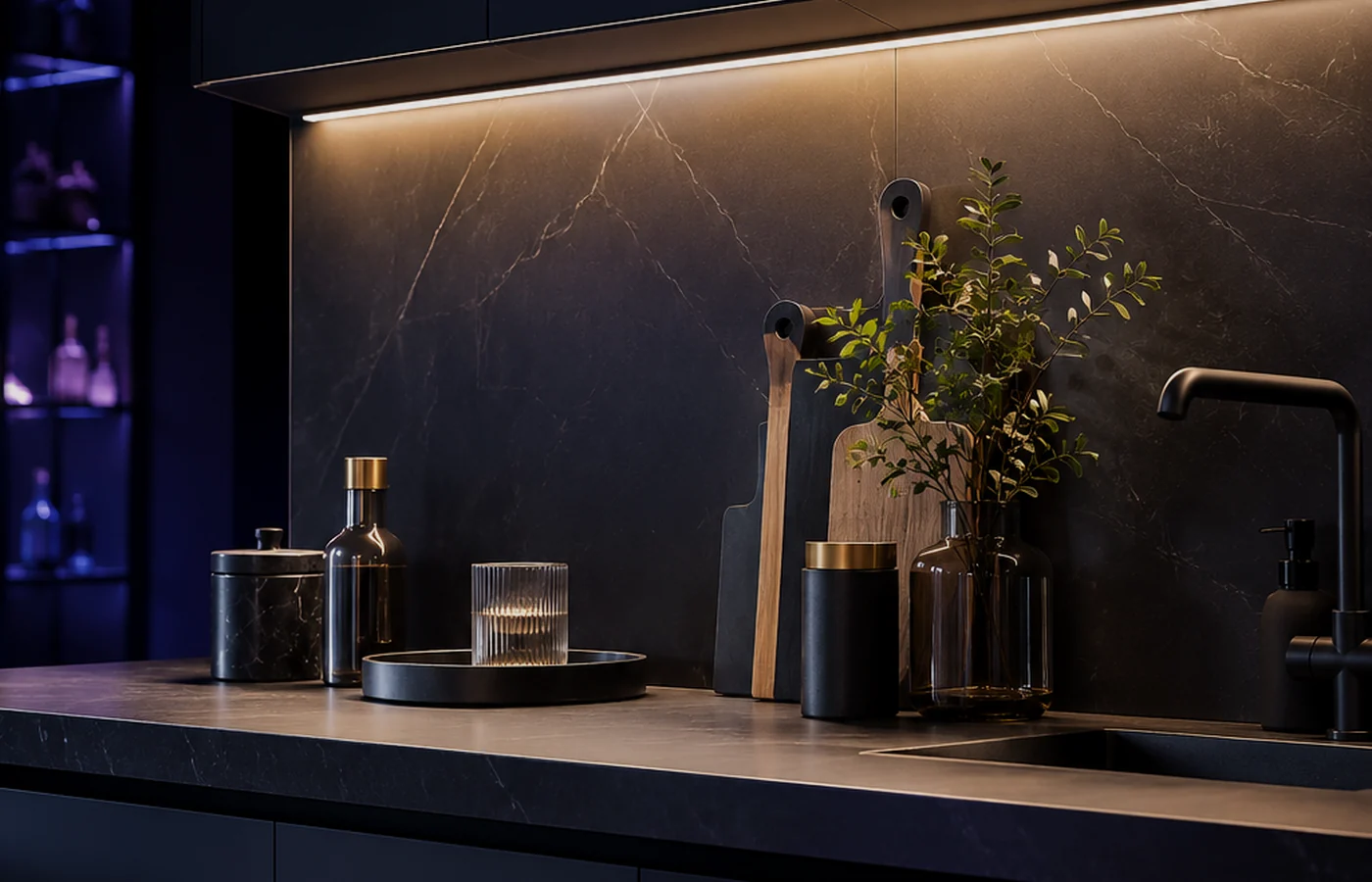
Interior lighting is specified in three layers: ambient light sets the base level that makes a room navigable, task light concentrates a higher illuminance over a worktop or reading chair, and accent light picks out one surface or object. IES residential guidance puts general living-room illuminance at roughly 100–200 lux and corridors at 50–100 lux. Every product in this group is accent light, and it depends on the ambient layer sitting at the bottom of that band or below it: a projected caustic or a sunset disc is a contrast effect, and contrast collapses as the general level rises.
Colour temperature sets both the appearance and the physiological weight of white light. 2700 K matches an incandescent filament and renders timber, textiles and skin warm; 6500 K matches the CIE D65 daylight reference and, at evening levels, reads grey and flat. Under the CIE S 026 metric a 2700 K LED delivers about half the melanopic stimulus of daylight at equal illuminance (MDER 0.47 against 1.0 for D65), and the CIE recommends low melanopic exposure in the evening because it supports sleep onset. Warm, dim ambient light after dark is a physiological choice as much as an aesthetic one.
Colour rendering applies to the white layer only. The general index Ra (CIE 13.3) compares eight test colours under the source with the same colours under a reference; EN 12464-1 sets Ra 80 as the minimum for rooms occupied for long periods, and Ra 90 is specified where the colour of wood, food or skin matters. A saturated RGB effect has no Ra value and is chosen for hue, not fidelity.
Glare is the failure a correctly built ambient layer avoids. The Unified Glare Rating runs from 10 (imperceptible) to 28 (uncomfortable), with 19 the limit for reading and screen work, and the rating rises as the background darkens — a bare LED in the line of sight in a dim room sits at the uncomfortable end of the scale. The working principle is to see the light and not the source: the emitter sits in a cove, behind a lip or under a cabinet edge, and the eye receives light reflected from the ceiling or wall, which diffuses the beam and removes the point-source luminance. Sunset lamps and projectors apply the same rule in reverse — the unit is placed out of the line of sight, and only its image on the wall is seen.
Product photographs of projection and ambient lighting are taken in a darkened room at a long exposure. The camera accumulates light over seconds; the eye does not, and adapts to the darkness instead. The visible effect of a sunset lamp or ripple projector is therefore softer than the listing image, and the gap closes through placement and throw distance rather than through a brighter unit.
Effect speed is the second shared variable. Factory defaults are set for a shop shelf, where a fast pattern draws attention; in a lived-in room the same speed reads as restless. Slowing the effect is the one adjustment that costs nothing and improves every product in this group.
Projection
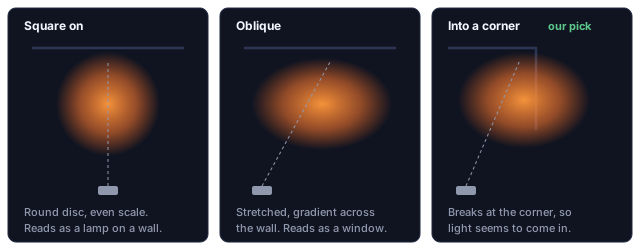
Sunset lamps: distance, angle, and why the room never looks like the photos
What a long-exposure photograph records that the eye does not; the placements that come closest by eye; the wall colours that break the disc; and the half-sun placement, which costs nothing.
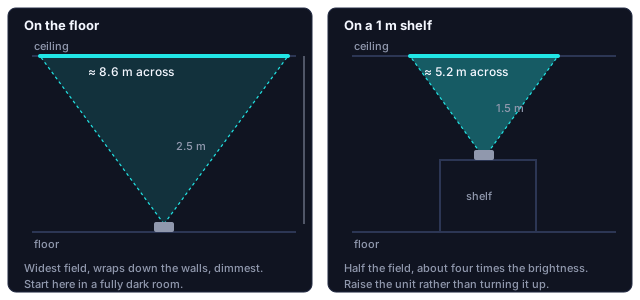
Star projectors: coverage, placement and rotation speed
Two projected layers with different requirements; ceiling coverage as a function of mounting height; the rotation speed that is set too fast by default; and the laser safety rules for units with a laser star element.
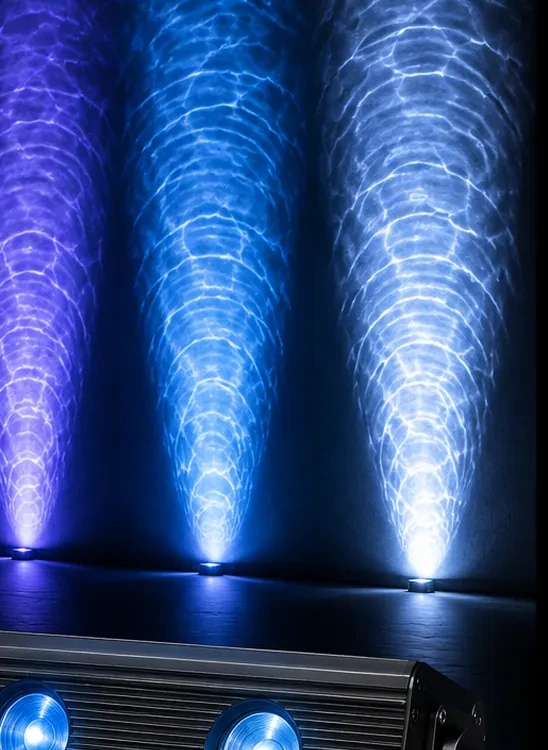
Water ripple lights: placement is the whole job
What the channel count changes; why doubling the throw distance quarters the illuminance; which surfaces hold a caustic pattern and which scatter it; and the slower speed at which every unit we have tested performs better.
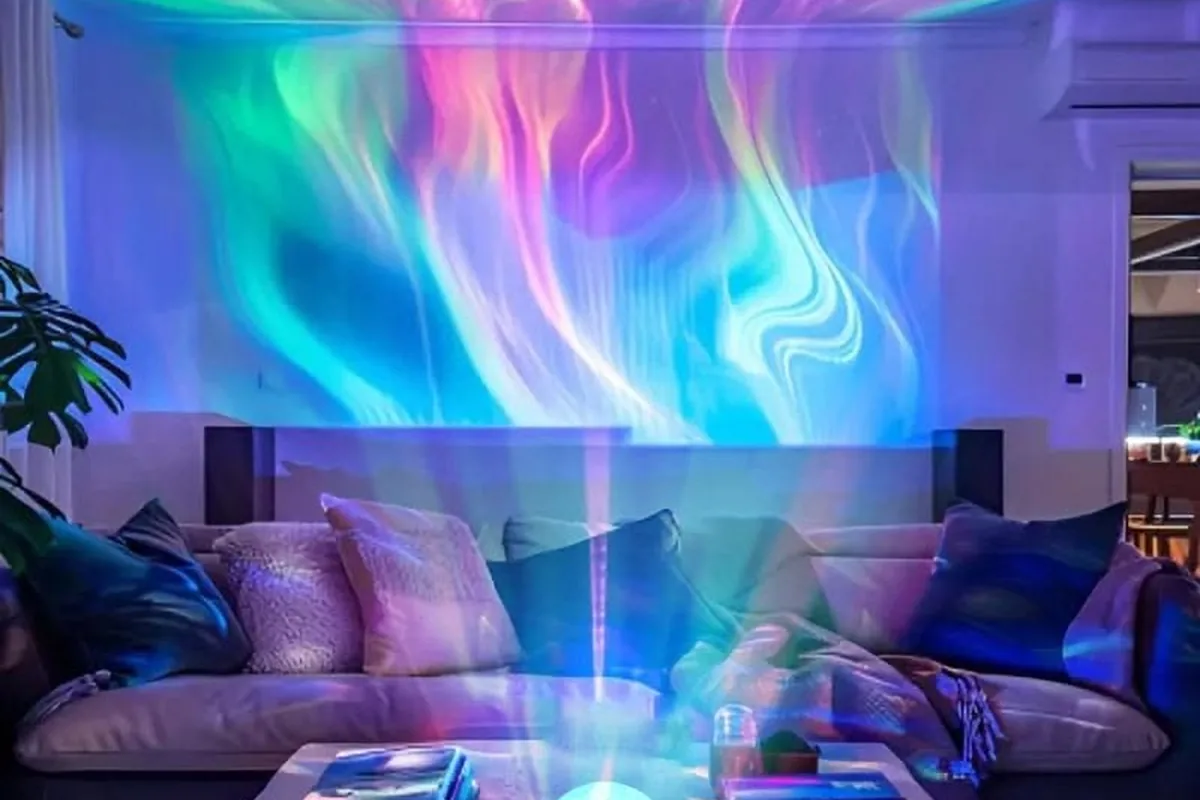
Star lights: how a galaxy projector works and which type to choose
Three constructions — laser stars over a moving nebula, planetarium-style optical projection, and a soft night light for a child's room — what is inside each, and the selection criteria for sleep, atmosphere or a gift.
Movement and reaction
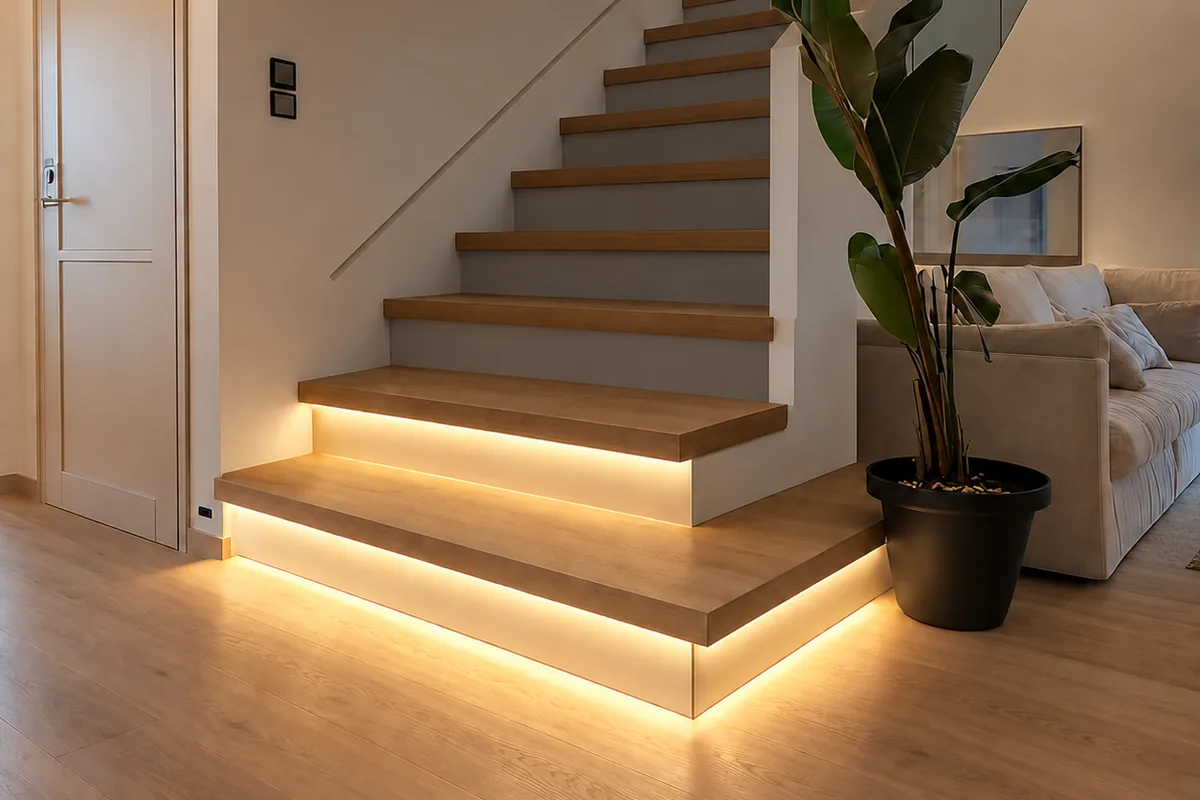
Stair running water lights: how the step-by-step effect works
A sensor at each end of the flight; one channel per step or a single addressable bus; a power supply sized with 20 percent headroom; the conduit that must be in the wall before plastering; and the retrofit options when it is not.
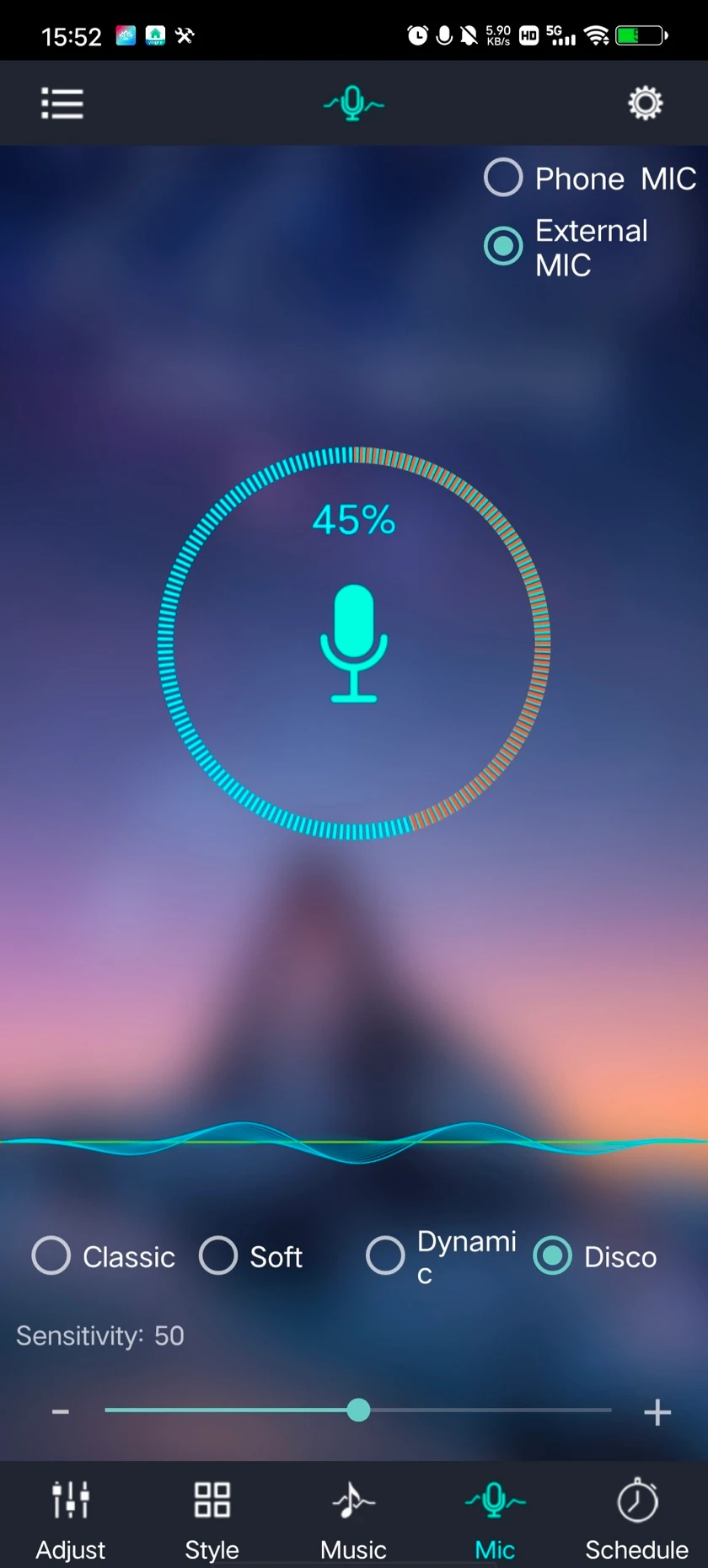
Sound-activated lights: the microphone is in the light
With the microphone inside the controller, the phone leaves the signal path and the mounting position decides response quality. Positioning, sensitivity, and the limits of sound reactivity.
Related
For music-reactive lighting the sync mode matters more than the fixture: the three sync modes explained covers the difference between the phone's music library, the phone's microphone and a microphone inside the controller.
The app that pairs with a given unit is listed in which app controls your light.
Sources: ANSI/IES/ALA RP-11-20, Lighting for Interior and Exterior Residential Environments; IES residential recommended light levels (summary table); CIE Position Statement on Non-Visual Effects of Light, 2nd edition (2019); Fagerhult, melanopic daylight efficacy ratio by colour temperature; CIE 13.3-1995, colour rendering properties of light sources; TRILUX, colour rendering and EN 12464-1; Ansell Lighting, Unified Glare Rating explained.