Y96: fixed-colour RGB control, three to five channels
Strip, string, downlight and lawn-light products that show one colour along their full length are built, on our controllers, around Y96. The platform switches three to five colour rails by pulse-width modulation from a deliberately small board, and takes commands from a phone over Bluetooth, from infrared, 433 MHz and 2.4 GHz remotes, and from buttons on the fixture.
Key takeaways
- Conductors on the strip equal channels plus one. RGB needs three channels, RGBW four, RGBCCT five; a mismatch leaves one rail unpowered.
- Each channel switches one rail and the common rail carries the sum. Full white on three channels puts three rails' current through the input connector at once.
- Infrared needs a receiver window in line of sight. 433 MHz and 2.4 GHz do not, and 2.4 GHz permits a sealed enclosure.
- A dim or warm-shifted far end is voltage drop. Inject power at the tail; a larger controller changes nothing.
- Red showing as green is rail order. Modify Pin Sequence in the app corrects it without rewiring.
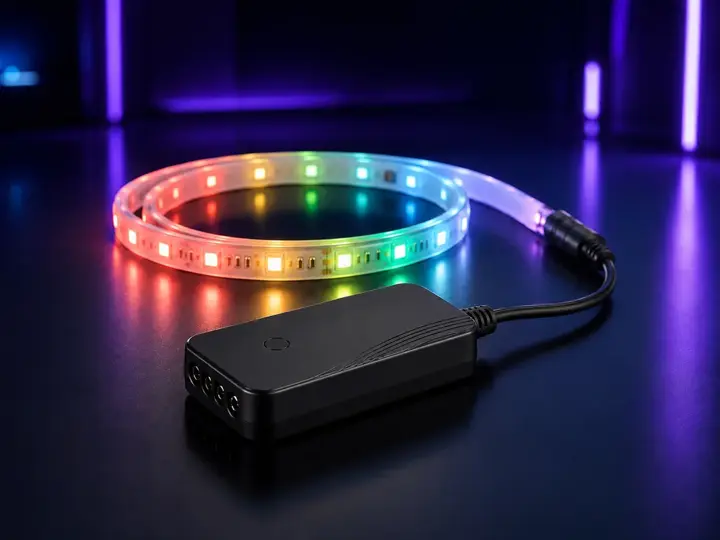
Fixed-colour control: colour rails under pulse-width modulation
A fixed-colour controller drives colour rails, not individual emitters. On an RGB strip every red emitter along the full length shares one conductor, every green a second, every blue a third, and all three return to a common positive. Each rail is switched to ground by its own low-side transistor, and the controller sets rail brightness by pulse-width modulation: the rail is fully on for a fraction of each cycle and fully off for the remainder, and the eye integrates the average. Every emitter on a rail is in the same state at the same instant, so the mix is identical from the first centimetre to the last.
The one visible side effect of PWM is its switching frequency. IEEE 1789-2015, the recommended practice for modulating current in high-brightness LEDs, places 100% modulation — on–off dimming — in its low-risk region from 1250 Hz upwards and in its no-observable-effect region from 3000 Hz upwards. Below those figures a run that looks steady to the eye can band on a phone camera, which samples a slice of the waveform rather than its average.
Addressable strip solves a different problem: each emitter sits behind its own driver IC and holds its own value, so colour can travel along the run, at the price of a data line, a pixel count to configure, a cut interval fixed by the driver grouping and less current capacity per metre at the same width. The two forms differ in installation, uniformity and appearance, not in grade:
| Criterion | Fixed-colour rails (Y96) | Addressable pixels (Y16) |
|---|---|---|
| Installation | Cut at any marked point; four to six conductors to terminate; no configuration | Cut only between driver groups; data-lead length matters; pixel count and wire order to set |
| Uniformity of light | Identical mix along the run; tail dimming and warm shift only from voltage drop | Each pixel independent; tail pixels shift warm, then drop out below the driver's minimum supply |
| Appearance | One colour on one plane of light: coves, eaves, string, lawn lights | Gradients and motion; the effect reads as light travelling |
| Current per metre | Higher: copper rails, no per-pixel logic | Lower at the same width: driver logic and the data trace occupy the strip |
A cove, an eave, a lawn light or a string that needs one colour, evenly belongs on rails; an effect that has to move belongs on the Y16 pixel platform.
Three, four and five channels
The platform ships in three output configurations. Channel count is the first parameter to match to the strip:
| Channels | Strip type | Conductors on the strip | Result |
|---|---|---|---|
| Three | RGB | Four — common positive plus R, G, B | Any mixed colour. White is mixed from all three and reads slightly cool and thin |
| Four | RGBW | Five — adds a dedicated white rail | White from a white emitter, plus pastels by mixing white into a colour |
| Five | RGB + tunable white (RGBCCT) | Six — adds warm-white and cool-white rails | Colour for atmosphere and a full warm-to-cool white range for task lighting |
The controller is selected for the strip, not the strip for the controller. A three-channel controller on a four-conductor RGBW strip leaves the white rail unpowered; a four-channel controller on an RGBCCT strip leaves one of the two white rails unpowered.
Four command paths: Bluetooth, three remote families and buttons
Y96 accepts commands over four paths, and they coexist: a fixture paired with a phone still answers a remote and its own buttons.
- Bluetooth, from the phone. The Lotus Lantern app sets colour, brightness and colour temperature, switches modes, runs music sync and sets timers. The phone connects directly to the fixture, without a hub, and pairing needs no account.
- Infrared remote. The lowest-cost path. A 940 nm emitter modulated on a 38 kHz carrier is decoded by a receiver behind a window in the enclosure; the link needs clear line of sight, and receiver modules are rated for roughly 8 m. A fixture behind a pelmet or inside a cabinet cannot be driven this way.
- 433 MHz remote. Radio at a wavelength of about 70 cm, which diffracts around furniture and passes interior partitions with little loss: the remote works through cupboard doors and from an adjacent room. Button codes are written to the controller at build time (see customisation below).
- 2.4 GHz remote. Radio in the same band as the Bluetooth link, wavelength about 12.5 cm, no receiver window: the path that permits a fully sealed enclosure. The remote is built on a dedicated 2.4 GHz transmitter or a Bluetooth LE SoC, supports short-press, long-press and a sleep state for battery life, and addresses a single light, a group or a zone.
- Buttons on the fixture. Typically on/off, brightness and mode, so the light remains usable with a flat phone and a lost remote.
| Criterion | Infrared | 433 MHz | 2.4 GHz |
|---|---|---|---|
| Line of sight | Required; receiver window facing the room | Not required | Not required |
| Enclosure | Needs an infrared-transparent window | Closed; antenna inside | Closed and sealable; antenna inside |
| Reach indoors | About 8 m within the receiver's field of view | Through partitions; the longest of the three | Room scale; attenuated more by walls than 433 MHz |
| Cost position | Lowest | Highest of the three | Comparable to an infrared receiver |
Which remote a product carries is decided at build time: an outdoor lawn light is normally specified with a radio remote, a bedside strip with infrared. The platform implements most remote functions on any of the three.
Three-wire copper-wire strings
Beyond strip, Y96 drives copper-wire string lights, including the three-wire type. A two-wire string is a single circuit, and every emitter on it is in the same state. A three-wire string carries a common conductor and two separate returns, dividing the emitters into two interleaved groups; switching the groups alternately produces the alternating and two-colour chase effects a two-wire string cannot. The controller treats the two groups as two of its channels.
The check before pairing a controller with a string is the number of wires leaving it: two-wire strings take one channel, three-wire strings two, and a string with a data wire is addressable and belongs on Y16.
A short external component list, and what board size buys
Y96 is designed around a short list of external components. Fewer parts lower the cost of populating the board, simplify inspection and make repair practical, and they let the controller fit downlight bodies and lawn-light stakes as well as the connector box at the end of a strip. A platform that does one task simply goes into strip, string, downlight, spotlight and lawn-light products without redesign, which is what allows one app to control all of them in the same way.
Sizing: what the controller switches and what it does not
Each channel is a switch for the full current of one colour rail, so the load limit is per channel: a property of the specific product, printed on its label, not fixed by the platform. Two consequences follow.
First, the common rail carries the sum of the channels. A 12 V RGB strip of typical density draws about 0.2 A per colour rail per metre, so a 5 m reel at full white asks each channel for 1 A and the common rail and input connector for 3 A. Strip length and power has the arithmetic.
Second, the controller does not correct voltage drop. On a long run the far end receives less voltage and dims; on RGB it also shifts colour. Red emitters have a forward voltage of about 2.0–2.2 V against 3.0–3.4 V for green and blue, so the series resistor in each red group drops a larger share of the supply and red current falls more slowly as the supply sags: the far end goes warm or pink before it goes dark. Power injection at the tail corrects it; a larger controller does not.
What a product built on Y96 can be customised to do
For a light being specified rather than purchased, the platform exposes a set of items fixed at build time:
- Mode set. Which static and dynamic modes are present, and their order.
- Remote codes. The infrared or 433 MHz code values each button sends, so a product can ship with its own remote or match an existing one.
- Button functions. What the on-board buttons do — short press, long press, which modes they cycle through.
- Power-on animation. What the light does in the first seconds after power is applied.
- Music modes. Which reactive modes are present and whether they use an on-board microphone or an external microphone circuit.
- Strip or string. Whether the outputs are configured for strip rails or for copper-wire string groups.
Board outline, remote interface, button count and external microphone circuit are hardware variables; the app can be white-labelled. None of that changes what the platform does, only how a particular light presents it.
Mistakes we see most often
Red shows as green, or blue as red
The strip's rail order does not match the controller's channel order. Strip is labelled at the cut marks, but pad order varies between manufacturers, and a connector that lines the pads up in the wrong sequence is the usual cause. Swap the leads or change the channel order in the app; colours coming out wrong sets out the steps.
The white channel does nothing
Either the controller has fewer channels than the strip has rails, or the white conductor is not connected. Count the conductors on the strip and confirm the controller has one channel for each colour rail.
The remote works from the sofa but not from the doorway
An infrared remote needing line of sight. Either move the receiver window into view, or specify a radio remote for the next fixture.
The far end of the run is dimmer, or a different colour
Voltage drop, not the controller. Inject power at the far end or split the run into two shorter sections fed separately.
Common questions
Can Y96 drive an addressable (RGBIC) strip?
No. Addressable strip needs a data signal and per-pixel addressing; Y96 drives colour rails. Addressable strip on this platform will light one colour only, if it lights at all. That strip belongs on Y16.
Does the music mode use my phone's microphone?
Products built on this platform can carry their own microphone, in which case the light keeps reacting after the phone is put away. Music sync: three modes explains the difference between phone-driven and fixture-driven sync.
Which app runs it?
Lotus Lantern. Full mapping here, and first-time pairing if it is not showing up.
Contact us if you are specifying a product on this platform and need something that is not on the page.
Sources: IEEE 1789-2015; WS2812B datasheet, emitter forward voltages; Adafruit, RGB LED strips; Adafruit IR transceiver, 940 nm / 38 kHz; Vishay TSSP98038, 8 m; Homey, 433 MHz RF basics; AusChristmasLighting, LED string wiring.