Master–slave sync: many fixtures, one effect
Ambient strips in four doors, the dashboard and both footwells of a car: six fixtures that must breathe as one, not merely match. The master–slave platform locks them together. One master takes the phone's command over Bluetooth and rebroadcasts its own state by radio to every paired slave; no data cable runs between fixtures, and each slave needs only its local power feed.
Key takeaways
- Only the master talks to the phone and carries the microphone; slaves display the master's state, not a copy of a sequence.
- Sync error is bounded by one refresh interval plus radio latency and does not accumulate; a broadcast set drifts with time.
- No data wire between fixtures; each slave switches only its own strip, so the fused branch, not the master, carries the sum.
- Slaves do not relay; each must reach the master directly, so the master sits near the centre of the set.
- Doors not following the dash after a battery disconnect: confirm the master answers the phone, then re-pair the slaves.
How it is arranged
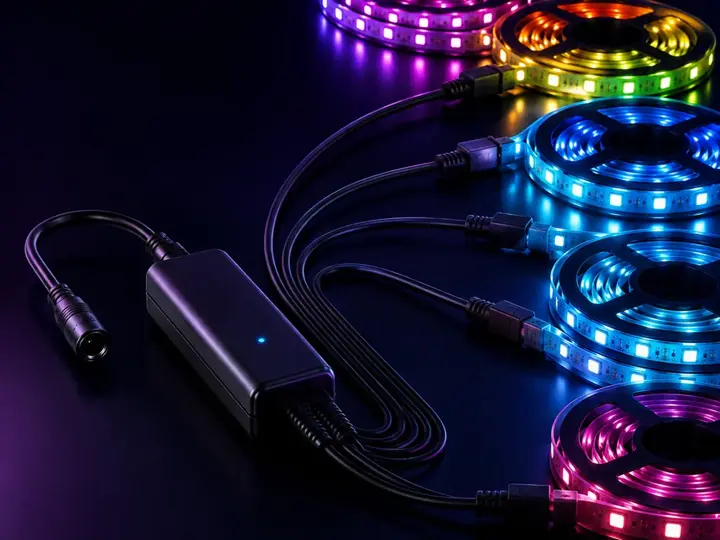
An installation on this platform has one master and any number of slaves. Only the master talks to the phone: the app connects to it over Bluetooth and sends colour, brightness, mode and timer commands as to a single light. The master applies the command to its own output and broadcasts the resulting state by radio to every slave paired to it; the slaves apply that state and show the identical result.
The microphone is also on the master. In a music mode the master's microphone samples the room, the master computes the light response and transmits that to the slaves — the decision, not the sound. Every fixture reacts to the same beat in the same way. A row of individually sound-reactive fixtures never achieves this: each microphone hears a different mix and each fixture decides alone.
| Dimension | Wired chain (one controller, strips in parallel) | Broadcast set (G01) | Master–slave radio |
|---|---|---|---|
| Installation efficiency | Data and power lines to every fixture, through door looms and under trim | Power only; each fixture paired once to the transmitter | Power only; each slave paired once to the master |
| Sync precision | Exact: one output stage drives every strip | Starts in step, then drifts on each fixture's clock | Bounded by one refresh interval plus radio latency; constant over time |
| Supply complexity | One output carries every strip's current; limited by channel rating and voltage drop | Each fixture's board switches its own load | Each slave switches its own strip; the fused branch carries the sum |
| Music response | One microphone, one decision | One microphone per fixture; each decides alone | One microphone on the master; one decision to all |
| Scaling limit | Channel rating and voltage drop on the shared run | Radio reach from the transmitter | Radio reach from the master; slave count adds no traffic |
What "100% synchronised" means, and what it does not
Synchronised here means that the slaves display the master's state, not their own copy of a sequence that started at the same time. On a broadcast set, one command starts a dynamic mode on every fixture, after which each runs on its own clock; with an internal RC oscillator at a typical ±1.5 %, two fixtures at opposite limits separate by up to 1.8 s per minute. On a master–slave set there is one clock, the master's, and each state update returns the slaves to it. The residual error is bounded by the interval between updates plus radio latency, and it does not accumulate. DMX512 stage lighting refreshes a full universe at most 44 times per second, about 23 ms per frame; a phase offset below one such frame is not perceptible from the driving seat.
It does not mean the slaves are interchangeable with the master. A slave has no microphone and no Bluetooth link to the phone; it executes the master's state, and without the master it has nothing to follow. The master is placed where the phone can reach it and its microphone can hear; the slaves go wherever the light is needed.
Why it matters in a car
Car ambient lighting is the defining application, for three reasons that come back to wiring.
- No data cable between fixtures. Otherwise each door, dash and footwell strip needs a data line threaded through door looms and under trim; a slave needs only power, which the vehicle already routes to every door.
- One phone connection. The driver pairs with the master once. The doors follow.
- One microphone. Six sound-reactive strips, each hearing the cabin differently, produce six different responses. One microphone, one decision, six identical responses reads as intentional.
The signal reaches each slave by radio; the current does not. Each slave switches only its own strip from a local branch of the 12 V feed, so the load is calculated per slave and per branch, never through the master. A 12 V RGB strip of the common 60-LED-per-metre 5050 type draws about 14.4 W, or 1.2 A, per metre at full white; six 30 cm sections total roughly 2.2 A on the fused branch, which sets the fuse-tap rating and cable gauge with about 20 % headroom. Our car interior ambient lighting guide covers the vehicle wiring.
The same applies wherever a data wire between fixtures is impractical: downlights across a ceiling, spotlights along a fence, corner lamps on opposite walls, a set of lawn lights.
How many slaves, and how far
One master can drive dozens of slaves and, in the right layout, over a hundred; because slaves do not reply, adding one costs the master nothing. Both links, phone to master and master to slaves, are designed for range and speed: a phone command is on every slave without perceptible delay.
The limit is radio reach from the master, not slave count. Every slave has to be within range of the master itself; slaves do not relay to each other, and each 6 dB of wall loss between them halves the reach. A set spread across a large space is placed with the master near its centre.
Few parts, low cost per fixture
A slave is deliberately simple: a radio receiver and an output stage, with very few external components. That is what makes one per door reasonable: the cost per fixture is close to a plain fixed-colour controller's, and the board fits where a strip's connector box would go. The master carries the Bluetooth link and the microphone; there is only one of it.
Control paths and modes
The phone runs the Lotus Lantern app and connects to the master over Bluetooth for colour, brightness, colour temperature, mode selection, music sync and timers. The master's own buttons, and buttons on the slaves where fitted, handle on/off, brightness and mode. Mode behaviour follows the fixed-colour RGB platforms beneath it: one colour at a time across the set, with dynamic and music modes applied identically everywhere.
What it is not for
It is not an addressable platform: colour does not travel along a strip, and each fixture shows one colour across its whole length. Moving effects are Y16. Nor is it the platform for a single fixture — a lone strip gains nothing from a master with no slaves, and the Y96 platform gives it a wider choice of remotes.
What a product on this platform can be customised to do
For an installation specification: the on-board switch, mode and button functions can be configured, and the app can be white-labelled. The master–slave relationship itself — which unit carries the phone link and the microphone — is fixed by the platform.
Mistakes we see most often
The doors are not following the dash
The slaves lost pairing, usually after the vehicle's battery was disconnected, or the master is unpowered. Confirm the master lights and answers the phone; then re-pair the slaves.
Music mode is sluggish or reacts to nothing
Only the master's microphone matters, and it is buried under trim or facing the wrong way. Move the master, or specify an external microphone circuit placed where the sound is.
One slave lags or drops out
Range from the master. Slaves do not relay; the far one must reach the master directly. Move the master toward the centre of the set.
The app cannot find the light
The app connects to the master only; a slave never appears in it. If the master is not listed, run through first-time pairing.
Common questions
Can I add slaves later?
Yes. Power the new slave and pair it to the master; the rest of the set is untouched.
Can two masters run in the same car or room?
Each slave follows its own master, so two independent sets coexist; they are not synchronised with each other, since each has its own clock.
Which app runs it?
Lotus Lantern, connected to the master. Full mapping here.
Sources: Fraunhofer; ENTTEC; HiLine Lighting; Xmart Lightings; noIM₃.
Contact us if you are designing a synchronised installation on this platform and need a further figure.