Can you add LED strip lights to the rear of a motorcycle?
A rear LED kit for a motorcycle arrives with a chase mode, a strobe mode and a strip long enough to run across the number plate. Those are the three things you must not use on the road. The tail lamp, brake lamp, indicators and plate lamp are approved equipment; decorative light can sit beside them and do nothing else.
Key takeaways
- Never replace, cover, tint or dim the tail lamp, brake lamp, indicators or plate lamp. Decorative strip only adds to them.
- The pattern almost everywhere: steady red to the rear, steady amber to the side, a short wash on the ground under the bike.
- No white light rearward, nothing flashing while moving, no blue anywhere. Those colours and patterns already mean something to other drivers.
- Virginia's rule is a useful template: red or amber, aimed at the ground, beam ending within 10 ft, no flashing. Read yours before buying.
- Vibration kills these installs first: support every joint, lock every connector, clip cable every 10 cm. Power it ignition-switched and fused.
What must stay exactly as the factory fitted it
Tail, brake, indicator and number plate lamps are type-approved for intensity, colour and beam pattern. A strip that looks brighter to you is not equivalent, and on a motorcycle the tail lamp is most of the reason a driver sees you at all. Nothing decorative may replace one of these lamps, sit in front of one, tint one, or spill colour onto the plate. Not partially, and not from any viewing angle.
| Lamp | What the rules fix | What that means for a decorative kit |
|---|---|---|
| Tail lamp | Red, steady, visible from a set distance: 500 ft in Minnesota, 1,000 ft in Connecticut | Extra steady red beside it is the least contentious addition. Nothing may sit in front of it. |
| Brake lamp | Red, steady, brighter than the tail lamp when either brake is applied | Do not tap its circuit for a trigger unless the controller has a brake input (see power, below). |
| Indicators | Amber, and the only lamps allowed to flash | Nothing else on the bike may flash. No amber where it could be read as an indicator. |
| Number plate lamp | White, plate legible from 50 ft behind | No coloured light on the plate, no strip across it, no tinted cover. |
| Rear reflector | Red | Leave it uncovered. |
The distances come from three US state codes, linked further down. The colour logic behind them is international, and it is short enough to learn:
| Where it is written | The rule in one line |
|---|---|
| UN Regulations 48 and 53, the type-approval rules for cars and motorcycles across Europe and much of Asia | No red light visible to the front, no white light visible to the rear. Only direction indicators, the hazard warning and the emergency stop signal may flash. |
| US FMVSS 108 | Tail and stop lamps red, plate lamp white, rear indicators amber. Added equipment must not impair a required lamp. Flashing is reserved for turn and hazard signals. |
| UK Road Vehicles Lighting Regulations 1989 | Regulation 11: no red to the front, no white to the rear except reversing lamps. Regulation 13: no flashing lamps other than indicators. |
| State and provincial codes | Add colour, aiming and brightness limits for auxiliary lighting, and reserve blue and flashing red for emergency vehicles, in combination and when stationary too. |
Rules differ by country and often by state or province, and enforcement on two-wheelers tends to be stricter than on cars. Check the rule where the machine is registered and where you ride before buying anything. We cannot advise for a specific jurisdiction, and a shop that calls a decorative kit "road legal everywhere" is guessing.
Where decorative light is usually tolerated
A starting point for checking your own local rule, not permission.
| Generally the least contentious | Generally a problem |
|---|---|
| Steady red light to the rear, in addition to and not obscuring the tail lamp | Any white light facing rearward |
| Amber to the side, steady | Anything flashing, chasing or sequencing while moving |
| Lighting under the machine that illuminates the ground rather than being seen directly | Blue or red flashing in any position |
| Show and paddock lighting used with the engine off | Colour-changing effects visible from outside while riding |
| Auxiliary lighting switched off in traffic if you are unsure | Anything mounted where it can be mistaken for an indicator |
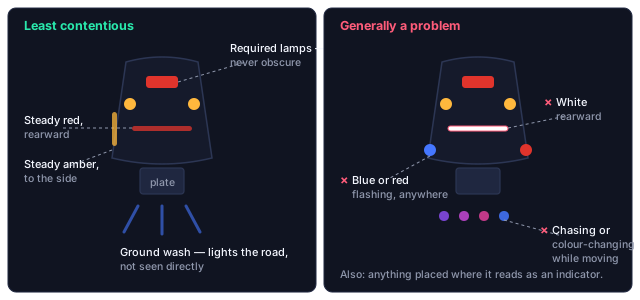
Keep decorative light steady and dim while riding, save effects for stationary use, and put a switch on it you can reach from the saddle. A kit you can turn off is a kit you can keep.
Chase and flow effects stay in the car park. The step-by-step sequencing that runs a stair running water light is the same control a rear chase effect uses, and a vehicle is the one application where it is regulated. Not while moving, in most places, and we would not run it on the road anywhere.
How to read the rule where you ride
"Check your local rules" is easy to say and hard to act on. These US state statutes are not the law where you are, but they show what kind of numbers to look for, and they are far more specific than any product listing.
| Requirement | How a statute puts it |
|---|---|
| Tail lamp | Red, and visible from 500 feet behind the vehicle. See Minnesota Statutes 169.50 |
| Number plate lamp | White, and the plate legible from 50 feet behind. See Connecticut General Statutes 14-96c |
| When they must be lit | Tail lamp and plate lamp wired so they light whenever the headlamp or auxiliary driving lamps are on. See RCW 46.37.525 |
| Decorative and auxiliary lighting | Red or amber only, aimed at the ground, no part of the beam reaching the road surface more than 10 feet from the machine, no brighter than 25 candlepower (the statute's own conversion is 314 lumens), not blinking, flashing, oscillating or rotating, and not fitted to the wheels. See Virginia Code 46.2-1012 |
| Inspection of a part-failed LED lamp | A multi-LED lamp on a motorcycle passes provided more than half its diodes still light. Any coloured material placed on or in front of a lamp is a rejection. See 19VAC30-70-360 |
Paraphrased from the linked statutes. Read the original before relying on any row.
The fourth row is the useful one. It is the only place most codes describe decorative lighting at all, and it describes it as a wash on the ground, not as something seen directly. Read that way, the legal space for decoration on a motorcycle is under the machine, pointed down, and short.
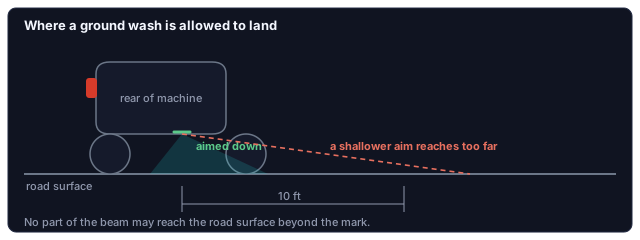
Check the aim in three steps
- Park on level ground after dark, decorative light on, engine off, and stand ten metres behind the bike. If you can see the LEDs themselves rather than a glow on the road, the strip is facing you, not the ground.
- Find where the pool of light ends and pace it. Three normal strides is about 3 m, which is the 10 ft in the Virginia rule. Light on the tarmac beyond that is too far.
- Angle it down or recess it. A strip stuck flat along the underside of a frame rail throws light sideways and along the road, which is why cheap kits fail this test. Tilting the same strip toward the tarmac, or tucking it behind a lip, is usually the difference between compliant and not.
Vibration is what actually breaks these installs
This surprises people who have done a car interior install first. A motorcycle subjects anything bolted to it to far more vibration and shock than a car does, and the worst place is exactly where people want to put lights: the tail, the mudguard tip, the number plate bracket. Those are the ends of cantilevers, so they see the largest accelerations on the whole machine.
What fails, in order:
- Solder joints. A joint with no strain relief work-hardens and cracks. It fails intermittently first, as a flicker over bumps, then permanently. If you solder, support the wire mechanically within a couple of centimetres of the joint so the joint carries no movement.
- Connectors backing out. Anything push-fit will eventually walk apart. Use locking connectors, and secure both sides so the connector body cannot move relative to either cable.
- Cable chafing. A cable resting against a frame tube saws through its own insulation. Secure every 10 cm on a bike, closer than the 15–20 cm you would use in a car, and sleeve anything crossing metal.
- Adhesive letting go. Tape does not survive here. Treat adhesive as positioning while you fit a mechanical retainer.
Do not hard-mount anything rigid to a plastic mudguard. The mudguard flexes and a rigid fixture concentrates that flex at the mounting point. Either mount to the frame or use a compliant mount that can move with the panel.
Water and road grit: worse than a garden
The rear of a motorcycle takes direct spray off the tyre: water carrying grit, salt in winter, and whatever is on the road. It arrives at pressure, from below, continuously, and it finds the connectors before it finds the strip.
- Fully sealed strip and sealed connectors. "Splash resistant" is a garden rating. The rear of a bike is a worse environment than a garden.
- Point every connector downward and seal it. Water wicks along the inside of a cable sleeve by capillary action and arrives at a connector you thought was dry, uphill of where it got in. Use heat-shrink with adhesive lining, and leave a drip loop below every connection so water leaves the cable before it reaches the joint.
- Do not mount anything where water can pool around it. Standing water gets in eventually, whatever the rating says.
- Keep everything clear of the exhaust. A silencer and its header run far hotter than any LED assembly tolerates, and radiant heat matters as well as contact. If you can hold your hand there after a ride, it is probably fine; if you cannot, nothing goes there.
- Wash with a hose, not a pressure washer. Pressure washing drives water past seals that handle rain indefinitely. This applies to the factory lighting too.
How to power it without flattening the battery
Small and mid-size machines have modest charging systems, and a good deal of that output is already committed to ignition, lighting and the battery. A decorative install is a small load, but it is not free, and on some bikes the surplus at idle is close to zero, which is why accessories sometimes only charge properly above a certain engine speed.
- Ignition-switched, always. Take the trigger from a circuit that is live only with the key on. Bikes sit unused for weeks and a small standby draw will flatten a small battery. A controller drawing 30 mA in standby is around 10 Ah over a fortnight, which on a motorcycle battery is most of it.
- Fuse the new branch at or below the rating of the wire you added, as close to the power source as you can get it.
- Use a relay if the load is meaningful rather than running current through a factory switch that was not sized for it.
- Take earth to a factory earth point. A convenient bolt into a painted or powder-coated bracket is not an earth, and it will produce flicker that looks like a controller fault.
Do not splice into the brake light circuit unless the controller is specifically designed for a brake trigger input and you have confirmed how your machine's brake circuit is monitored. On bikes with engine management that watches lamp circuits, adding load can set fault codes; on bikes with thermal flasher relays, changing load changes indicator timing. Neither is something to discover on the road.
If the real goal is being seen
Riders often conflate this with decoration. If your reason for adding rear lighting is that drivers do not see you:
- An approved brighter tail and brake lamp assembly, or an approved auxiliary brake lamp, does this properly and legally.
- Reflective material on the machine and on your kit works at night with no power and no legal question.
- Decorative strip does not meaningfully help. It is dim relative to an approved lamp, it is in the wrong place, and an unfamiliar light pattern takes another driver longer to interpret, not less.
Faults that show up after the first ride
It flickers only over bumps
A mechanical fault, not an electrical setting. Look for a cracked solder joint or a connector walking apart, then check the earth. Vibration-related faults are always mechanical first.
A warning light came on
The strip is connected to a circuit the ECU monitors for lamp presence. Move the decorative install to its own fused, ignition-switched branch and it stays invisible to the vehicle.
One section went dark after a wash
Water in a connector, almost always the lowest one or the one facing forward into the spray. Dry it, reseal it with lined heat-shrink, and add the drip loop it should have had.
What to do now
Read the auxiliary lighting rule for where the bike is registered, then buy a kit that only does steady red or amber and has a switch you can reach. Plan the feed as an ignition-switched, fused branch to a factory earth before the strip is stuck anywhere. Our automotive controllers run on LotusLamp X: the full app mapping is here. Set scenes with the machine parked.
Questions about a specific controller of ours? Contact us.